

Saṁsara Mohanam – the delusion of the World
"Saṁsara Mohanam" - refers to the concept of being "deluded by Saṁsara," where Saṁsara is the cycle of birth, death, and rebirth driven by karma and desire, and Mohanam means delusion or attachment. It's a state of being trapped in this cycle, failing to see the suffering and impermanence inherent in it due to ignorance, craving, and aversion, a state often associated with spiritual delusion and the need for liberation through spiritual practices, meditation and prayer.
The invincibly powerful deluding energy of the Personality of God, or the third energy, representing nescience, can bewilder the entire world of animation. Bhagavad-gītā, Text 7.27 states: “All living entities are born into delusion, overcome by the dualities of desire and hate.”
“From anger, delusion arises (krodhād bhavati sammohaḥ), and from delusion bewilderment of memory (sammohāt smṛti-vibhramaḥ). When memory is bewildered, intelligence is lost, and when intelligence is lost, one falls down again into the material pool.” (Bg 2.63)
“Deluded by the three modes [goodness, passion and ignorance], the whole world does not know Me who am above the modes and inexhaustible.” (Bg 7.13)
“From the mode of goodness, real knowledge develops; from the mode of passion, grief develops; and from the mode of ignorance, foolishness, madness and illusion develop.” (Bg 14.17)
“Those who are not faithful on the path of devotional service cannot attain Me, O conqueror of foes, but return to birth and death in this material world. (mṛtyu-saṁsāra)” (Bg 9.3)
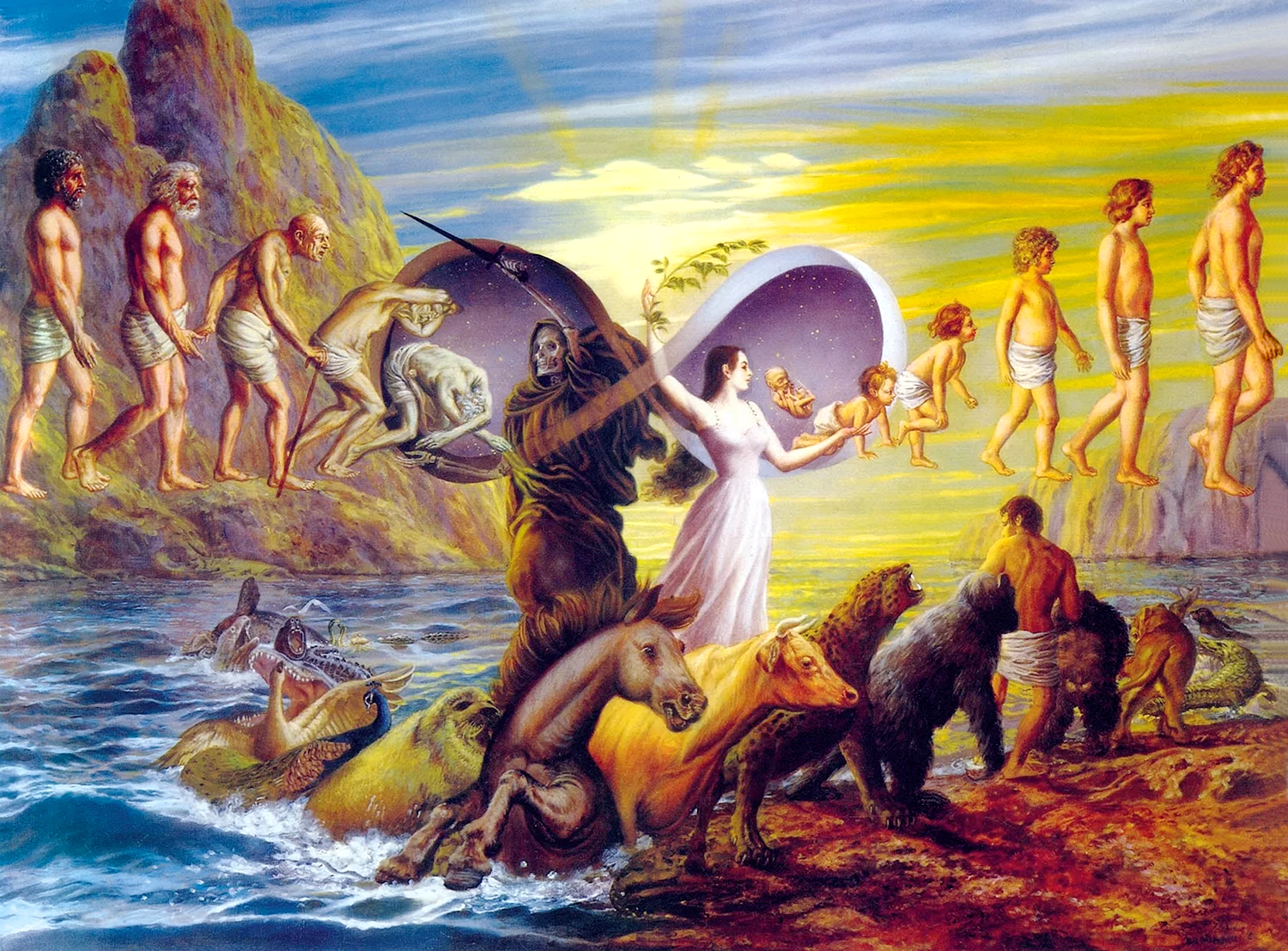
Mṛtyu-saṁsāra. What is this saṁsāra? Saṁsāra means that you take your birth once and live for some time, then you die, then you accept another body, then again live for some time, then you die, then you accept another body, and that body you do not know what kind of body you are going to accept. Tathā dehāntara-prāptiḥ (Bg 2.13). Kṛṣṇa says, dehāntara-prāptiḥ: another..., transfer to another body. But what kind of body, that is not mentioned there. That will depend on your work. You may get the body of a demigod, you may get the body of a dog, you may get the body of a tree, you may get the body of a snake—according to your karma.
The aim of human civilization is to stop the repetition of birth and death, which is called mṛtyu-saṁsāra-vartmani - na mocayed yaḥ samupeta-mṛtyum.
Saṁsara
- The cycle of existence: The continuous, repetitive cycle of birth, death, and rebirth, a core concept in several Indian religions like Buddhism and Jainism. According to the Gītā, Saṁsāra refers to the cycle of birth, death, and rebirth that living entities undergo within the material universe. It is characterized by the constant transmigration of the soul from one body to another, influenced by one's karma (actions) and the modes of material nature (sattva, rajas, and tamas). This cycle is often described as a source of suffering and is compared to a forest fire (dāvānala), which occurs without anyone desiring it, yet causes distress to all beings caught within it
- Characterized by suffering (dukha): This cycle is seen as inherently unsatisfactory, involving suffering such as birth, sickness, aging, and death.
- Driven by karma and desire: Actions (karma) and unresolved desires and attachments propel beings through this cycle.
Mohanam
- Delusion or attachment: In this context, "Mohanam" refers to the mental state of delusion, confusion, or deep attachment to the temporary and unsatisfactory experiences of the world.
- The root of suffering: This delusion is a key part of the "three poisons" (ignorance, attachment, and aversion) that keep one trapped in Saṁsara.
Summary
- Saṁsara Mohanam is the state of being deluded by and attached to the cycle of existence. It is a lack of understanding of the true nature of reality, leading to a cycle of craving and aversion that perpetuates suffering and rebirth.
- Liberation: Breaking free from this state of "Saṁsara Mohanam" is the ultimate goal, which is achieved by following spiritual paths (like the Noble Eightfold Path in Buddhism) or the worship of Kṛṣṇa, to overcome ignorance and desire and attain a state of liberation or enlightenment (Nirvāṇa or Mokṣa). Salvation, or mukti, according to the Gītā refers to the liberation of the soul from the cycle of birth and death (samsara) and the material existence characterized by suffering and ignorance. It is achieved through the realization of one's true identity as a spirit soul, distinct from the material body, and through the cultivation of Kṛṣṇa consciousness.
Every living entity under the spell of material energy is held to be in an abnormal condition of madness.
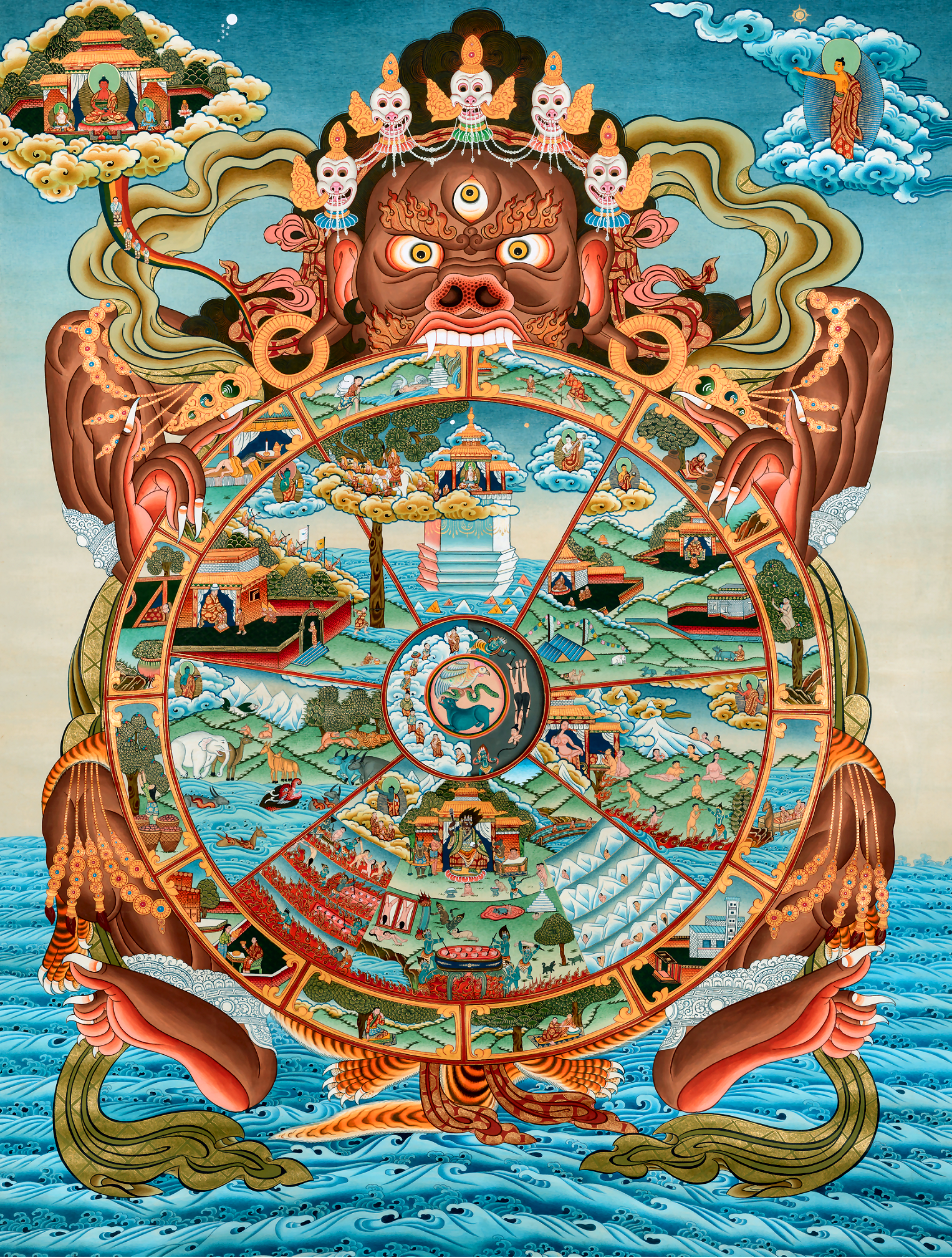 In Śrīmad-Bhāgavatam it is said, "Generally, the conditioned soul is mad, because he is always engaged in activities which are the causes of bondage and suffering." Spirit soul in his original condition is joyful, blissful, eternal and full of knowledge. Only by his implication in material activities has he become miserable, temporary and full of ignorance. This is due to vikarma. Vikarma means "actions which should not be done." Therefore, we must practice sādhana-bhakti—which means to offer maṅgala-ārati (Deity worship) in the morning, to refrain from certain material activities, to offer obeisances to the spiritual master and to follow many other rules and regulations which will be discussed here one after another. These practices will help one become cured of madness. As a man's mental disease is cured by the directions of a psychiatrist, so this sādhana-bhakti cures the conditioned soul of his madness under the spell of māyā, material illusion.
Every living entity under the spell of material energy is held to be in an abnormal condition of madness. In Śrīmad-Bhāgavatam it is said, "Generally, the conditioned soul is mad, because he is always engaged in activities which are the causes of bondage and suffering." (Nectar of Devotion, Chapter 2)
Anger causes delusion
As explaind in the Gītā: "From anger, complete delusion arises" (krodhād bhavati sammohaḥ). This delusion breaks down our knowing how to tell right actions from wrong ones.
Anger severely clouds our judgment. Anger creates a state where we "no longer know what actions to take or avoid." This state of sammoha (delusion) clouds our reasoning so much that we might "do anything in this condition."
A normally ethical person might say or do things completely out of character in a fit of rage. Their values haven't changed—anger has just blocked their access to those values temporarily. The Gītā's insight helps us learn about how to control anger by spotting early warning signs before delusion takes over.
Delusion destroys memory and intellect
Delusion brings the next consequence: "From delusion, bewilderment of memory" (sammohāt smṛti-vibhramaḥ). This isn't about forgetting daily tasks—it's nowhere near that simple. It means losing touch with spiritual teachings and moral principles.
The Gītā explains this confusion as "forgetting the truths from Vedic scriptures taught by the spiritual master." Modern people might call it forgetting our core values and highest aspirations when anger takes hold.
The damage continues: "When memory is bewildered, intelligence is lost" (smṛti-bhraṁśād buddhi-nāśo). Buddhi means our higher ability to separate truth from lies and right from wrong. Without it, we lose our moral and spiritual direction.
Loss of intellect guides us to downfall
The final stage hits hard: "And when intelligence is lost, one falls down again into the material pool" (buddhi-nāśāt praṇaśyati). This "falling down" means complete spiritual destruction.
The Vedic scriptures explain that "One loses focus on life's purpose and lives in ignorance." Madhvacharya adds that this downfall can lead to "degraded hellish planets" from sinful acts done under delusion's influence.
The Gītā's explanation of this chain reaction gives us more than just philosophy—it's a practical roadmap for mind control and spiritual growth. Learning how material desires lead to downfall helps us stop this process early and avoid the inevitable suffering from unchecked mundane desires.
Desire and Hate
Due to desire and hate, the ignorant person wants to become one with the Supreme Lord and envies Kṛṣṇa as the Supreme Personality of Godhead. Pure devotees, who are not so deluded or contaminated by desire and hate, can understand that Lord Śrī Kṛṣṇa appears by His internal potencies, but those who are deluded by duality and nescience think that the Supreme Personality of Godhead is created by material energies. This is their misfortune. Such deluded persons, symptomatically, dwell in dualities of dishonor and honor, misery and happiness, woman and man, good and bad, pleasure and pain, etc., thinking, "This is my wife; this is my house; I am the master of this house; I am the husband of this wife." These are the dualities of delusion. Those who are so deluded by dualities are completely foolish and therefore cannot understand the Supreme Personality of Godhead. The real constitutional position of the living entity is that of subordination to the Supreme Lord, who is pure knowledge. When one is deluded into separation from this pure knowledge, he becomes controlled by illusory energy and cannot understand the Supreme Personality of Godhead. The illusory energy is manifested in the duality of desire and hate.
The whole world is enchanted by three modes of material nature. Those who are bewildered by these three modes cannot understand that transcendental to this material nature is the Supreme Lord, Kṛṣṇa. In this material world everyone is under the influence of these three guṇas and is thus bewildered. So Lord Kṛṣṇa says that men, deluded by these three modes of nature, do not understand that behind the material background is the Supreme Godhead.
How to End Saṁsara - the circle of Birth & Death
Śrīla Prabhupāda: Because people have no knowledge about the next life, they are not interested with the spiritual education. That is the difficulty. They are not at all interested. They are so dull. Saṁsāreṣu narādhamān. Saṁsāra means this material entanglement. This is called saṁsāra. And narādhama. They are called the lowest of the human kind, because human life is especially meant for God realization, self-realization. So instead of realizing oneself and the Supreme Self, if one derides, doesn't want to understand what is God, what is God consciousness, what is Kṛṣṇa, he is to be understood as the lowest of the mankind, narādhama. Adhama means lowest. Or, in other words, he is an animal in the form of a man. Narādhameṣu. And birth after birth, such atheist is put into the species of life where there is no chance of understanding God.
One who wants to become free, who wants to become liberated, must first of all learn that he is not this material body. We are spirit souls, temporarily encaged in a material body. Mukti, or liberation, means freedom from material consciousness, or nescience. Liberation means getting out of the slumber of forgetfulness and becoming situated in the real loving service of the Lord, in devotional service called Bhakti-yoga.
Bhakti is a trandendental, spiritual process aiming at getting a person out of Saṁsāra - the ocean of birth and death. The ocean of birth and death is the material world, where we have come to enjoy our material body. Bhakti is the process that teaches one to give up material desires, and get out of Saṁsāra. In Saṁsāra everything is bodily and mentally oriented, ie. materially oriented. In bhakti-yoga everything is spiritual and God oriented, so in that way the two are opposed to each other.
But in order to get out of Saṁsāra, one must also learn about Saṁsāra, and how it works. It’s like, for a doctor to cure a patient from a disease, in order to find the cure, he must first study the disease, and learn how it works.
So to understand that the material world is nescience (ignorance), one must learn how this nescience works. There is no more deluded person than one who doesn’t know he is ignorant, especially in terms of spiritual knowledge. Such a person cannot get out of ignorance, even by good instructions. A person who knows he is ignorant, can also get out of ignorance.
Only one who can learn the process of nescience and that of transcendental knowledge side by side can transcend the influence of repeated birth and death and enjoy the full blessings of immortality.
—Śrī Īśopaniṣad 11
The most wonderful thing in the world
Yudhiṣṭhira Mahārāja, he was asked, "What is the most wonderful thing in the world?" He replied... He was very learned king. "Yes. The most learned thing, most wonderful thing in the world..." You, you have heard seven wonderful things in the world. So Yudhiṣṭhira Mahārāja said: ahany ahani lokāni gacchanti yama-mandiram. Yama-mandira means "the temple of death." Every minute, every second, we are experiencing that living entities are going to the temple of death, either man, animal, ant, so many. This world is called therefore mṛtyu-loka, "the planet for death." "The planet for death." So Yudhiṣṭhira Mahārāja said, ahany ahani lokāni gacchanti yama-mandiram. Ahani, ahani means daily, every day, every moment. At least every day we see so many death list. If you go to the crematorium ground, you can see.
***
Download PDF
Samsara-Mohanam.pdf