

The Brahma-gāyatrī Mantra
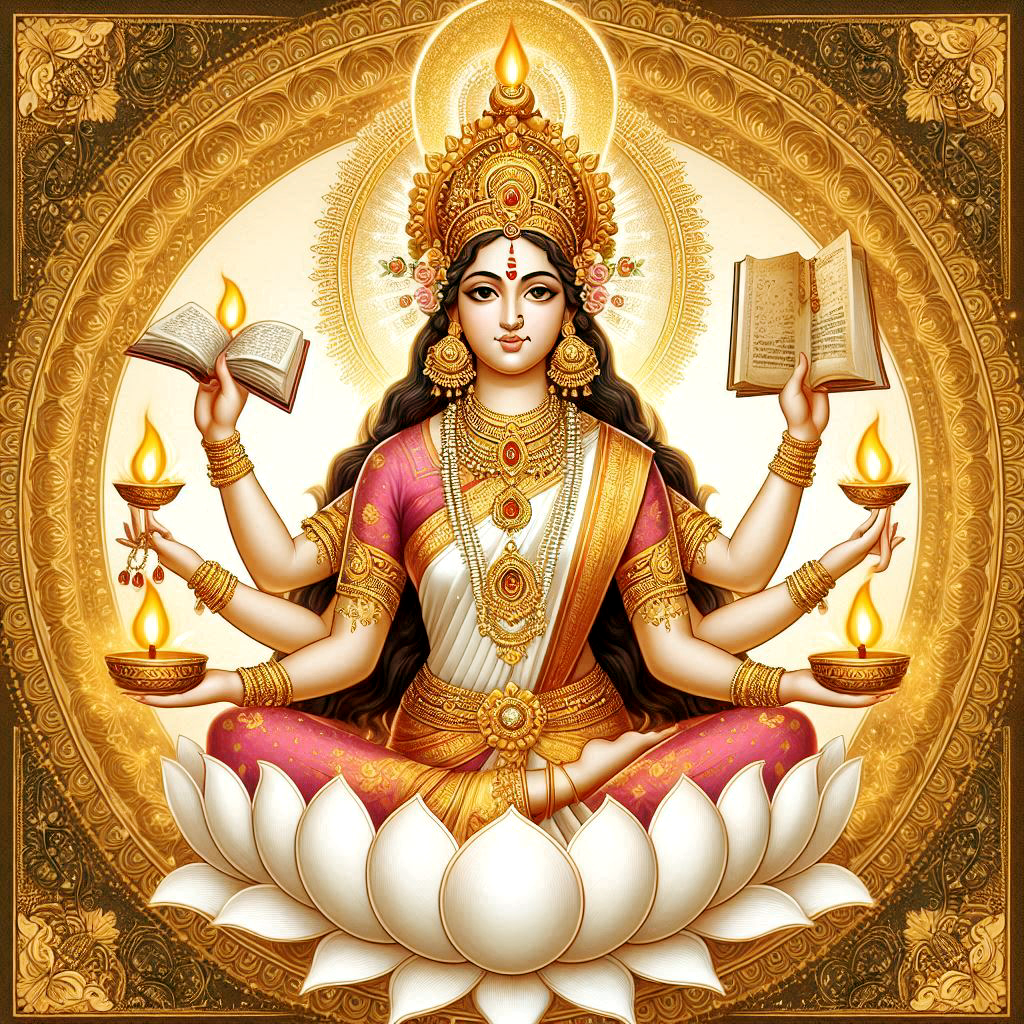
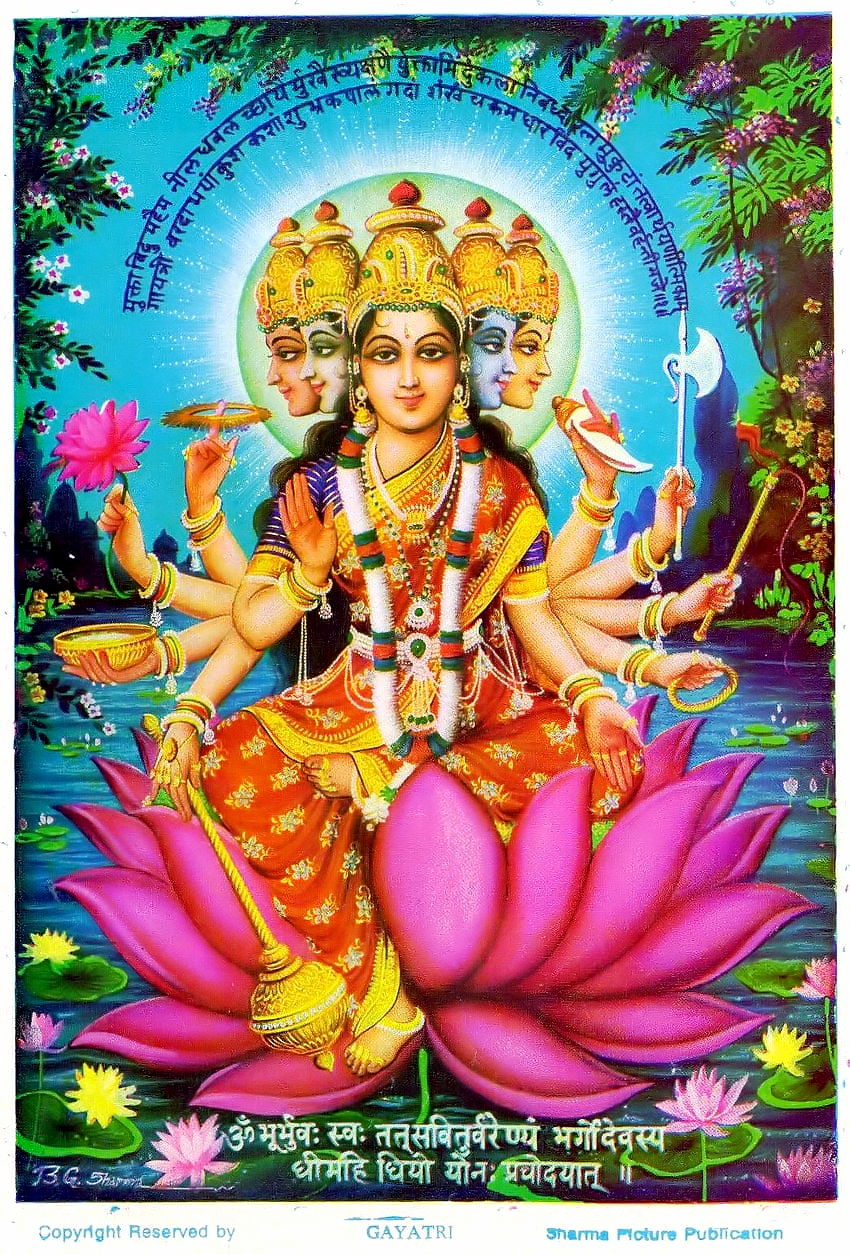
There are numerous Gāyatrī mantras but the main one, of twenty-four syllables, is sometimes called ‘Savitri’ or also Brahma-gāyatrī. Śrīla Prabhupāda translated the Brahma-gāyatrī as follows:
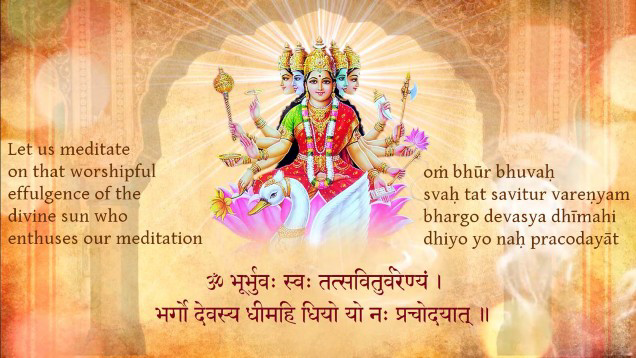
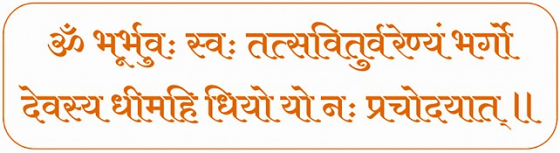
ॐ भूर्भुवः स्वः तत्सवितुर्वरेण्यं ।
भर्गो देवस्य धीमहि धियो यो नः प्रचोदयात् ॥
oṁ bhūr bhuvaḥ svaḥ
tat savitur vareṇyaṁ
bhargo devasya dhīmahi
dhiyo yo naḥ pracodayāt
(Rig-Veda 3.62.10).
oṁ -Invocation of the Lords Energy; bhūr — the planetary system, earthern sphere; bhuvaḥ — the next higher planetary system, the heavenly sphere; svaḥ — the celestial spere of the gods; tat — that; savituh — of the sun; vareṇyaṁ — worshipable; bhargo — effulgence; devasya — of the divine; dhīmahi — let us meditate; dhiyaḥ —meditation; yaḥ — who; naḥ — us; pracodayāt — enthuses.
“Let us meditate on that worshipable effulgence
of
the divine sun who enthuses our meditation.”
When we chant the Gāyatrī mantra we meditate on the sun. The light of the sun permeates the three planetary systems, bhūḥ, bhuvaḥ, and svaḥ, and fills them with life. This meditation on the divine light of the sun fills us with enthusiasm.
Purport: The predominating Deity within the sun is Hiraṇmaya. Lord Nārāyaṇa. He is worshiped by the Gāyatrī mantra: oṁ bhūr bhuvaḥ svaḥ tat savitur vareṇyaṁ bhargo devasya dhīmahi. He is also worshiped by other hymns mentioned in the Ṛg Veda, for instance: dhyeyaḥ sadā savitṛ-maṇḍala-madhya-vartī. Within the sun, Lord Nārāyaṇa is situated, and He has a golden hue.
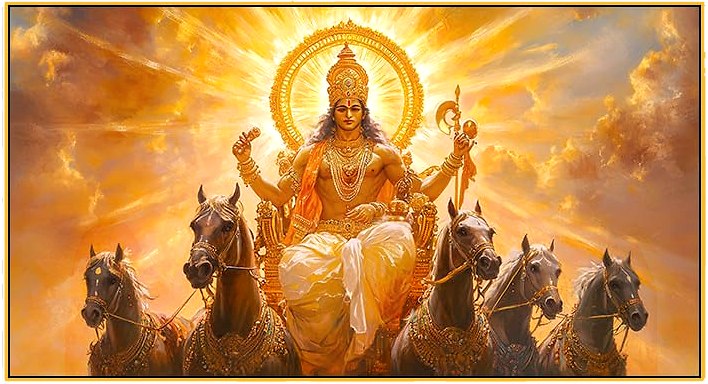
Surya-Nārāyaṇa -- the Sun God
Mahārāja Bharata worshiped Lord Nārāyaṇa, whose body was composed of golden effulgence and who resided within the sun. Mahārāja Bharata worshiped Lord Nārāyaṇa by chanting the hymns given in the Ṛg Veda, and he recited the following verse as the sun rose. (SB/5/7/13)
Here, Śrīla Prabhupāda explains the Brahma-gāyatrī as sun worship on a morning walk — May 7,1975, Perth:
“...it is said that sun is the source of everything within this universe. Maintenance of all living entities. It is the origin. The source within the universe is the sun. So therefore this Gāyatrī mantra is worshiping the sun, om bhūr bhuvah svaḥ tat savitur vareṇyaṁ bhargo devasya dhīmahi.”
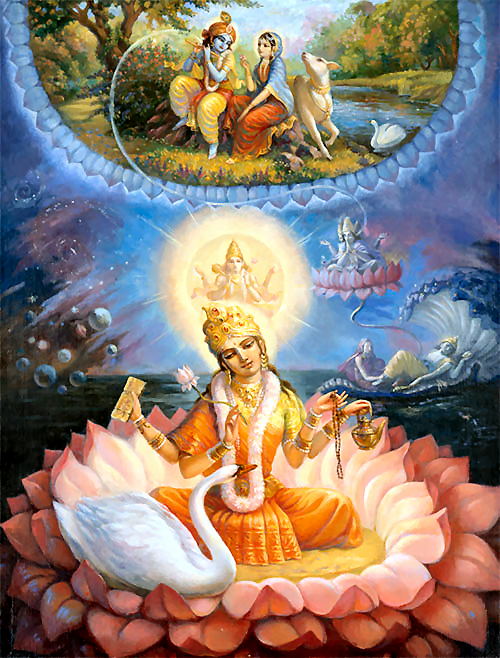
The vibration of Kṛṣṇa's flute is the origin of the Vedic hymns. Lord Brahmā, who is seated on a lotus flower, heard the sound vibration of Kṛṣṇa's flute and was thereby initiated by the Gāyatrī mantra.
Then Gāyatrī, mother of the Vedas, being made manifest, i.e. imparted, by the divine sound of the flute of Śrī Kṛṣṇa, entered into the lotus mouth of Brahmā, born from himself, through his eight ear-holes. The lotus-born Brahmā having received the Gāyatrī, sprung from the flute-song of Śrī Kṛṣṇa, attained the status of the twice-born, having been initiated by the supreme primal preceptor, Godhead Himself. (Śrī Brahma-saṁhitā 5.27) When Brahmā was enlightened by the gāyatrī mantra through Kṛṣṇa's flute, he attained all Vedic knowledge.
A mantra is a Vedic hymn. The Gāyatrī-mantra is a very special Vedic hymn, which emanates auspiciousness and purity. As the sun arises, one should chant the Vedic mantra beginning with the Gāyatrī. The sun is the symbolic representation of the eyes of the Supreme Lord.
Gāyatrī -mantra means it is chanted by a qualified Brahmin. A devotee of Krishna is understood to have surpassed the stage of becoming qualified Brahmin, so Gāyatrī-mantra can be chanted by qualified Brahmin, and the meaning of Gāyatrī-mantra is Gayat—Gayat means sin, and tri means deliverance. Gāyatrī. And mantra, man—means mind, tra means deliverance. So the things chanting which one is delivered from the mental platform is called Gāyatrī-mantra, or mantra. So all mantras are like that, but this is the meaning of Gayatri-mantra. (Letter to Syama)
In the Gāyatrī-mantra, we chant, oṁ bhūr bhuvaḥ svaḥ tat savitur vareṇyam. The word bhūr refers to Bhū-maṇḍala. Tat savitur vareṇyam: the sunshine spreads throughout Bhū-maṇḍala. Therefore the sun is worshipable. Above the Bhūloka planetary system is Bhuvarloka, and above that is Svargaloka, the heavenly planetary system. All these planetary systems are controlled by Savitā, the sun-god. By chanting the Gāyatrī-mantra just after rising early in the morning, one worships the sun-god. (SB 5:1:31pp).
“Of hymns I am the Bṛhat-sāma sung to the Lord Indra, and of poetry I am the Gāyatrī verse, sung daily by brāhmaṇas.”
In Sanskrit, there are definite rules that regulate poetry; rhyme and meter are not written whimsically, as in much modern poetry. Amongst the regulated poetry, the Gāyatrī mantra, which is chanted by the duly qualified brāhmaṇas, is the most prominent. The Gāyatrī mantra is mentioned in the Śrīmad-Bhāgavatam. Because the Gāyatrī mantra is especially meant for God realization, it represents the Supreme Lord. This mantra is meant for spiritually advanced people, and when one attains success in chanting it, he can enter into the transcendental position of the Lord. One must first acquire the qualities of the perfectly situated person, the qualities of goodness according to the laws of material nature, in order to chant the Gāyatrī mantra. The Gāyatrī mantra is very important in Vedic civilization and is considered to be the sound incarnation of Brahman. Brahmā is its initiator, and it is passed down from him in disciplic succession. (BG 10.35pp)
“The conditioned souls are engaged in a struggle for existence. Simply by chanting the Gāyatrī mantra, one can be delivered. Usually only Brahmanas and Twice-born initiated where allowed to chant this mantra. In Kali-yuga, everyone is in a very difficult position. Only a powerful mantra can deliver one from the dangers of this age. Therefore the Supreme Personality of Godhead, in His incarnation as Lord Caitanya, gives us the Hare Kṛṣṇa mantra, which can be chanted by everyone, anywhere and everywhere” (SB 8.6.15 p.)
***
Download PDF
brahma-gayatri-mantra.pdf
***
https://www.youtube.com/watch?v=1GvvSXlDIHA&list=RD1GvvSXlDIHA
https://www.youtube.com/watch?v=v2QMWlVAyD8&list=RDv2QMWlVAyD8