

Śrī Gaṇeśa Stotram - from Nārada Purāṇa
Śrī Saṅkaṭanāśana Gaṇeśa Stotram -- This Stotram is is a beautiful Sanskrit prayer addressed to Lord Gaṇeśa, to remove all obstacles. Saṅkaṭa means problems, difficulties and Nāśana means to destroy. So, by chanting this stotram, one is praying to Lord Gaṇeśa (who is the remover of obstacles) to remove all impediments in life. This stotram is from Nārada Purāṇa. Chanting this stotra with full devotion destroys obstacles in life, and brings all desired results - health, wealth, progeny and liberation.
ॐ
* Śrī Gaṇeśāya Namaḥ *
|| श्री सङ्कटनाशन गणेश स्तोत्रम् ||
śrī saṅkaṭanāśana gaṇeśa stotram
Eight Prayers in Glorification of Śrī Gaṇeśa
with Word-to-Word translation
from Nārada Purāṇa
नारद उवाच ।
nārada uvāca —
Nārada says:
ॐ प्रणम्य शिरसा देवं गौरीपुत्रं विनायकम् ।
भक्तावासं स्मरेन्नित्यम् आयुः कामार्थसिद्धये ॥ १॥
oṁ praṇamya śirasā devaṁ gaurī-putraṁ vināyakam |
bhaktāvāsaṁ smarennityam āyuḥ kāmārthasiddhaye || 1||
praṇamya–obeisances; śirasā–with head bowing down; devaṁ–deva, God, Lord); gaurīputraṁ–Son of Gauri (Pārvatī devī); vināyakam–Vināyaka (Gaṇeśa); bhaktāvāsaṁ–with full bhakti (devotion); smarennityam–one should remember everyday; āyuḥ–lifespan; kāmārtha–fulfillment of desires; siddhaye–success, accomplishments (will gain).
Bowing my head to the Lord, the son of Gaurī, Vināyaka (Gaṇeśa), who is the refuge of his devotees, I remember Him daily, with full devotion, for the attainment of long life, fulfillment of desires, wealth and success (in all endeavors). (1)
प्रथमं वक्रतुण्डं च एकदन्तं द्वितीयकम् ।
तृतीयं कृष्णपिङ्गाक्षं गजवक्त्रं चतुर्थकम् ॥ २॥
prathamaṁ vakratuṇḍaṁ ca ekadantaṁ dvitīyakam |
tṛtīyaṁ kṛṣṇa-piṅgākṣaṁ gajavaktraṁ caturthakam || 2||
prathamaṁ–First; vakratuṇḍaṁ–one having a curved trunk (Vakratuṇda); ca–and; ekadantaṁ–one having single tusk (Ekadanta); dvitīyakam–Second; tṛtīyaṁ–Third; kṛṣṇa-piṅgākṣaṁ–one with reddish brown/black eyes (Kṛṣṇapiṅgākṣa); gajavaktraṁ–one who has the face of an Elephant (Gajavaktra); caturthakam–Fourth.
Think of him (Gaṇeśa) First as the god with a curved trunk (Vakratuṇḍa), Second as the Lord with one single tusk (Ekadanta), Third as the one with reddish black eyes (Kṛṣṇa-piṅgākṣa), Fourth as the one who has the face (mouth) of an elephant (Gajavaktra). (2)
लम्बोदरं पञ्चमं च षष्ठं विकटमेव च ।
सप्तमं विघ्नराजं च धूम्रवर्णं तथाष्टमम् ॥ ३॥
lambodaraṁ pañcamaṁ ca ṣaṣṭhaṁ vikaṭameva ca |
saptamaṁ vighnarājaṁ ca dhūmravarṇaṁ tathāṣṭamam || 3||
lambodaraṁ–one with a large Belly (Lambodara); pañcamaṁ–Fifth; ca–and; ṣaṣṭhaṁ–Sixth; vikaṭam eva–horrible, dreadful, ferocious [to his enemies] (Vikaṭa); ca–and; saptamaṁ–Seventh; vighnarājaṁ–the King in removing all Obstacles (Vighnarāja); ca–and; dhūmravarṇaṁ–smoky, dark or grey-coloured, (Dhūmravarṇa); tathāṣṭamam–Eight.
Fifth as the one who has a big belly (Lambodara), Sixth as the one who is ferocious to his enemies (Vikaṭa), Seventh as the one who is the King of removing obstacles (Vighnarāja), Eighth as the one who is of the colour of smoke (Dhūmravarṇa). (3)
नवमं भालचन्द्रं च दशमं तु विनायकम् ।
एकादशं गणपतिं द्वादशं तु गजाननम् ॥ ४॥
navamaṁ bhālacandraṁ ca daśamaṁ tu vināyakam |
ekādaśaṁ gaṇapatiṁ dvādaśaṁ tu gajānanam || 4||
navamaṁ–Ninth; bhālacandraṁ–moon-crested, one with the Moon on his Forehead (Bhālacandra); ca–and; daśamaṁ–Tenth; tu–but, indeed; vināyakam–the remover of obstacles (Vināyaka); ekādaśaṁ– Eleventh; gaṇapatiṁ–the Chief of Gaṇas or Celestial Attendants, (Gaṇapati); dvādaśaṁ–Twelfth; tu–but, indeed; gajānanam–one with an Elephant's Face, (Gajānana).
Ninth as the moon-crested one, wearing the moon on his forehead (Bhālachandra), Tenth as the remover of hindrances (Vināyaka), Eleventh as the leader of the Gaṇa’s, heading the army of Lord Śiva (Gaṇapati), and Twelfth as the one who has the face of an elephant (Gajānana). (4)
द्वादशैतानि नामानि त्रिसन्ध्यं यः पठेन्नरः ।
न च विघ्नभयं तस्य सर्वसिद्धिकरं परम् ॥ ५॥
dvādaśaitāni nāmāni trisandhyaṁ yaḥ paṭhennaraḥ |
na ca vighnabhayaṁ tasya sarvasiddhi karaṁ param || 5||
dvādaśaitāni–these Twelve; nāmāni–names; trisandhyaṁ–three times a day, [Dawn, Noon and Evening]; yaḥ–he who; paṭhen naraḥ–any person who is reading or reciting; na–not; ca–and; vighnabhayaṁ–no fear of obstacles; tasya–to him; sarva siddhi–all accomplishments, perfections; karaṁ–will happen; param–the Supreme, God.
Any one reading these twelve names, at dawn, noon and dusk, will never have fear of defeat or failure, and would, by the grace of God, always achieve whatever he wants. (5)
विद्यार्थी लभते विद्यां धनार्थी लभते धनम् ।
पुत्रार्थी लभते पुत्रान् मोक्षार्थी लभते गतिम् ॥ ६॥
vidyārthī labhate vidyāṁ dhanārthī labhate dhanam |
putrārthī labhate putrān mokṣārthī labhate gatim || 6||
vidyārthī–Seekers of Knowledge; labhate–Gain; vidyāṁ–Knowledge; dhanārthī–Seekers of Wealth; labhate–will Gain; dhanam–Wealth; putrārthī–Seeking Children, Son’s; labhate–State, Destination; putrān–Son; mokṣārthī–Liberation; labhate–achives, obtains; gatim–State, Condition.
One who pursues education and desires knowlwdge will get knowledge, One who wants to earn money will get money, One who wishes for a son, will get a son, And one who wants salvation obtains the way. (6)
जपेत्गणपतिस्तोत्रं षड्भिर्मासैः फलं लभेत् ।
संवत्सरेण सिद्धिं च लभते नात्र संशयः ॥ ७॥
japet-gaṇapati-stotraṁ ṣaḍbhir-māsaiḥ phalaṁ labhet |
saṁvatsareṇa siddhiṁ ca labhate nātra saṁśayaḥ || 7||
japet–Reciting, Praying, Chanting [this Hymn]; gaṇapati–of Śrī Gaṇapati; stotraṁ–this Hymn; ṣaḍbhir-māsaiḥ–within Six Months; phalaṁ–the Fruits (thereof); labhet–will Gain; saṁvatsareṇa–for one Year; siddhiṁ–all Accmplishments; ca–and; labhate–will Gain; nātra–no Doubt in this; saṁśayaḥ–no Doubt.
Whosoever chants the hymn of Gaṇapati reaches his aim in six months, and within a year he reaches perfection and all his wishes would get fulfilled, on this point there is no doubt. (7)
अष्टभ्यो ब्राह्मणेभ्यश्च लिखित्वा यः समर्पयेत् ।
तस्य विद्या भवेत्सर्वा गणेशस्य प्रसादतः ॥ ८॥
aṣṭabhyo brāhmaṇebhyaśca likhitvā yaḥ samarpayet |
tasya vidyā bhavetsarvā gaṇeśasya prasādataḥ || 8||
aṣṭabhyo–Eight, to eight; brāhmaṇebhyaś–Brāhmaṇas(learned people); ca–and; likhitvā–in writing; yaḥ–this, he who; samarpayet–offers; tasya–this; vidyā–Knowledge; bhavetsarvā–all will be coming into Existence; gaṇeśasya–Lord Gaṇeśa; prasādataḥ–by the Grace of.
Whosoever makes eight copies of this prayer, and has them distributed to as many brāhmaṇas (or wise people), to him will come all knowledge instantaneously, being blessed by the grace of Lord Gaṇeśa. (8)
|| इति श्री नारदपुराणे संकटनाशनम गणेश स्तोत्रम सम्पूर्णम ||
|| iti śrī nārada purāṇe saṅkaṭanāśanaṁ gaṇeśa stotraṁ saṁpūrṇam ||
Thus ends the prayer from Nārada Purāṇa
to Gaṇeśa which would destroy all sorrows.
***
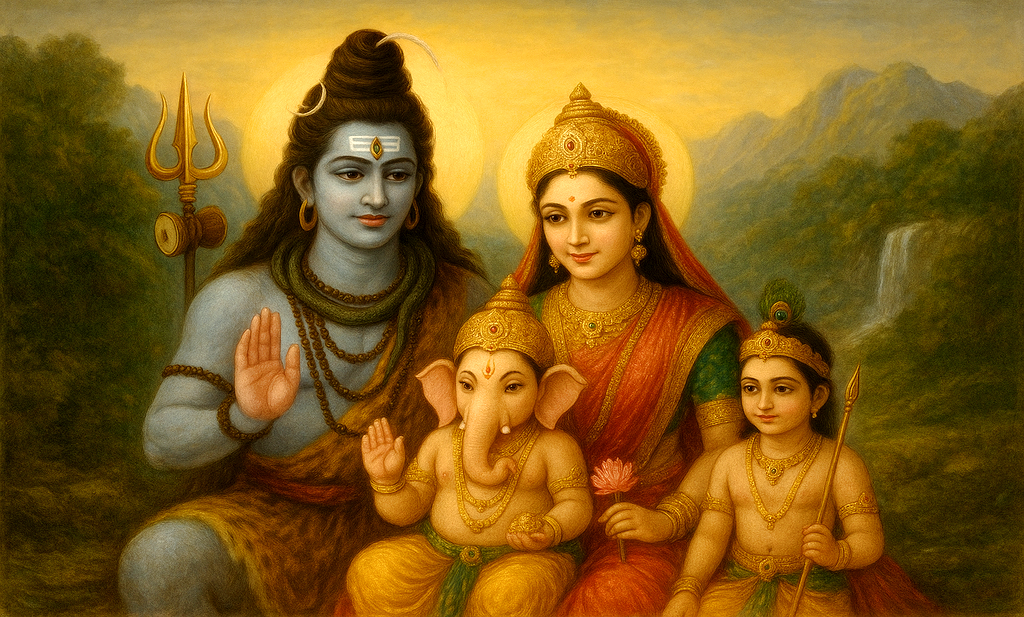
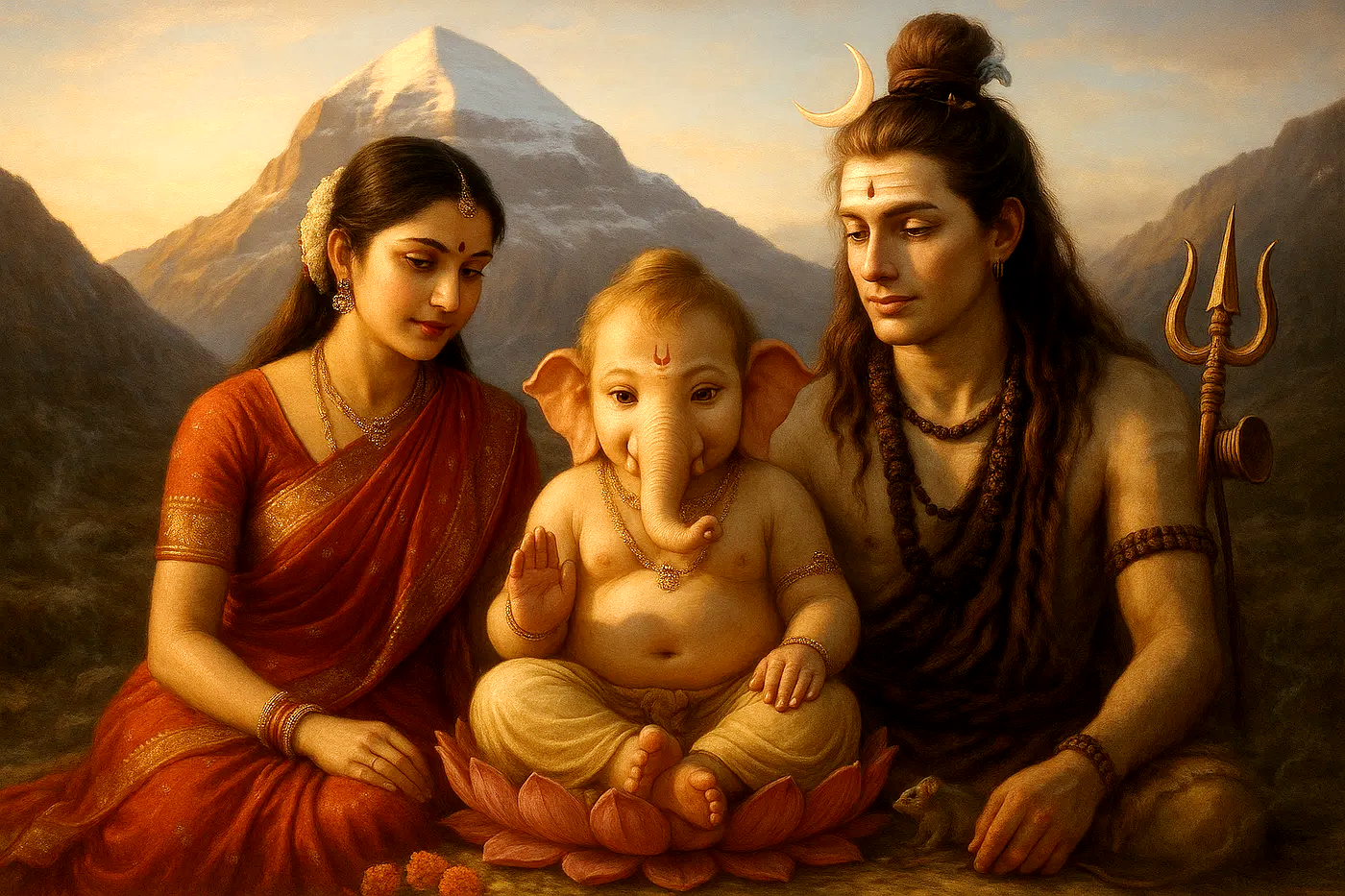
Śrī Gaṇapati is the elephant headed son of Lord Śiva, belonging to the divine family that delivers the soul from darkness and sin. The specific function of Śrī Gaṇapati is to teach knowledge (Vidyā) and drive away ignorance (Avidyā)
Gaṇeśa’s elder brother is Kārttikeya, who is also known as Skanda, Muruga, Subrahmanya, or Shanmukha.
Lord Gaṇeśa and Kārttikeya are two contrasting personalities described in the Purāṇas. The relation between them is distinct mainly as differences in their temperament. While lord Gaṇeśa is worshipped throughout India, Kārttikeya has more influence towards South India. Together, they represent different aspects of divine assistance, with Gaṇeśa focusing on obstacles in life's path and Kārttikeya embracing the martial spirit, showcasing the balance between overcoming challenges and the pursuit of victory.
***
Śrī Saṅkaṭanāśana Gaṇeśa Stotram is a beautiful Sanskrit prayer addressed to Lord Gaṇeśa, to remove all obstacles. Saṅkaṭa means problems, difficulties and Nāśana means to destroy. So, by chanting this stotram, one is praying to Lord Gaṇeśa (who is the remover of obstacles) to remove all impediments in life. This stotram is from Nārada Purāṇa. Chanting this stotra with full devotion destroys obstacles in life, and brings all desired results - health, wealth, progeny and liberation.
Each verse of the stotram holds significance and is chanted to invoke Gaṇeśa's divine presence, in his different forms, for overcoming all difficulties.
Lord Gaṇeśa’s twelve different names should be recited in all three time periods of the day. It frees a person from all kinds of impediments and destroys all sorrows. As said in the stotram itself, when prayed with sincerity, results will happen within six months.
The stotram begins with Nārada offering salutations to Gaṇeśa, the son of Gaurī (Pārvatī), who resides in the hearts of devotees and grants longevity, desires, and prosperity. Sage Nārada, praises Lord Gaṇeśa through his twelve names, each representing a unique aspect of the deity.
I pray to Lord Vināyaka, who is beyond the three qualities of nature, and who is the embodiment of truth, consciousness, and bliss. May he bless us with his divine grace.
***
COMMENTS
While watching the rāsa dance performed by Lord Kṛṣṇa and the gopīs, Lord Śiva beheld the beautiful face of Kṛṣṇa and immediately began to dance and beat upon his small ḍiṇḍima drum. While Lord Śiva was dancing in ecstasy, his eldest son, Ganeśa, joined him. {Śrīla Prabhupada, Nectar of Devotion Ch. 27 page 219}
One should begin the worship of the demigod Gaṇapati, who drives away all impediments in the execution of devotional service. In the Brahma-saṁhitā it is stated that Gaṇapati worships the lotus feet of Lord Nṛsiṁhadeva, and in that way has become auspicious for the devotees in clearing out all impediments. Therefore, all devotees should worship Gaṇapati. {Śrīla Prabhupada, Nof D Ch. 8 pg. 71}
I adore the primeval Lord Govinda, whose lotus feet are always held by Gaṇeśa upon the pair of tumuli protruding from his elephant head in order to obtain power for his function of destroying all the obstacles on the path of progress of the three worlds. {Śrī Brahma-samhita: Text 50}
PURPORT {By His Divine Grace Śrīla Bhaktisiddhānta Sarasvatī Gosvāmī Mahārāja}
"The power of destroying all obstacles to mundane prosperity has been delegated to Gaṇeśa who is the object of worship to those who are eligible to worship him. He has obtained a rank among the five gods as Brahmā possessing mundane quality. The self-same Gaṇeśa is a god in possession of delegated power by infusion of the divine power. All his glory rests entirely on the grace of Govinda."
{Śrī Gaṇeśa likes Mahā-prasādam. One can get some Deity Mahā-sweets at the local Temple and/ or offer incense and flowers and Maha-water and sweet-balls at home to a nice picture or Deity of Śrī Gaṇeśa.}
***
Gaṇeśa: Remover of Obstacles
by Satyarāja Dāsa / BTG
THE JOYOUS ELEPHANT-FACED DEITY known as Gaṇeśa is revered by one billion Hindus worldwide, and though his worship has little place in the modern-day Hare Kṛṣṇa movement, his personality and pastimes are part of ISKCON's heritage.
Gaṇeśa is often seen as the creator and remover of obstacles, as the guardian at entrances, and as a spiritually potent figure who can avert all evil influences. In popular Hindu lore he is thus the god to be worshiped first, before all religious ceremonies, public and private. Things tend to start off with Gaṇeśa, and this is reflected even in common idiomatic phrases. For example, in Maharashtra when a dedication or inauguration is to be performed, a Marathi speaker may refer to the occasion as Śrī gaṇeśa kāraṇe ("doing the Śrī Gaṇeśa"). Another such expression is ganapatice kele ("to conceive a child"). Similar phrases are found in other Indian languages.
Since Gaṇeśa is considered the lord of beginnings, for the first installment in this series about the demigods we start with him.
According to the Vedic literature, behind the workings of the cosmos stand powerful controllers, known as devas, or demigods. As we people in this world control our cars or homes, and the ministers of the government control the citizens, similarly the devas control various aspects of the cosmos.
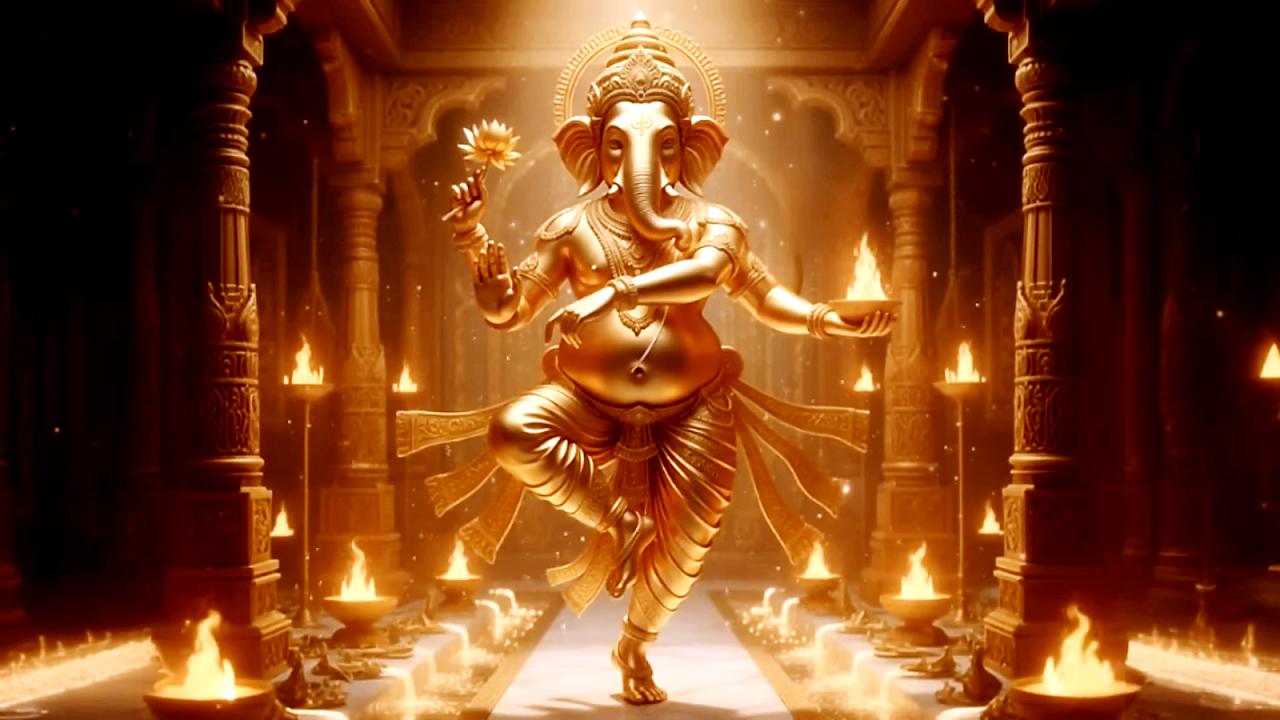
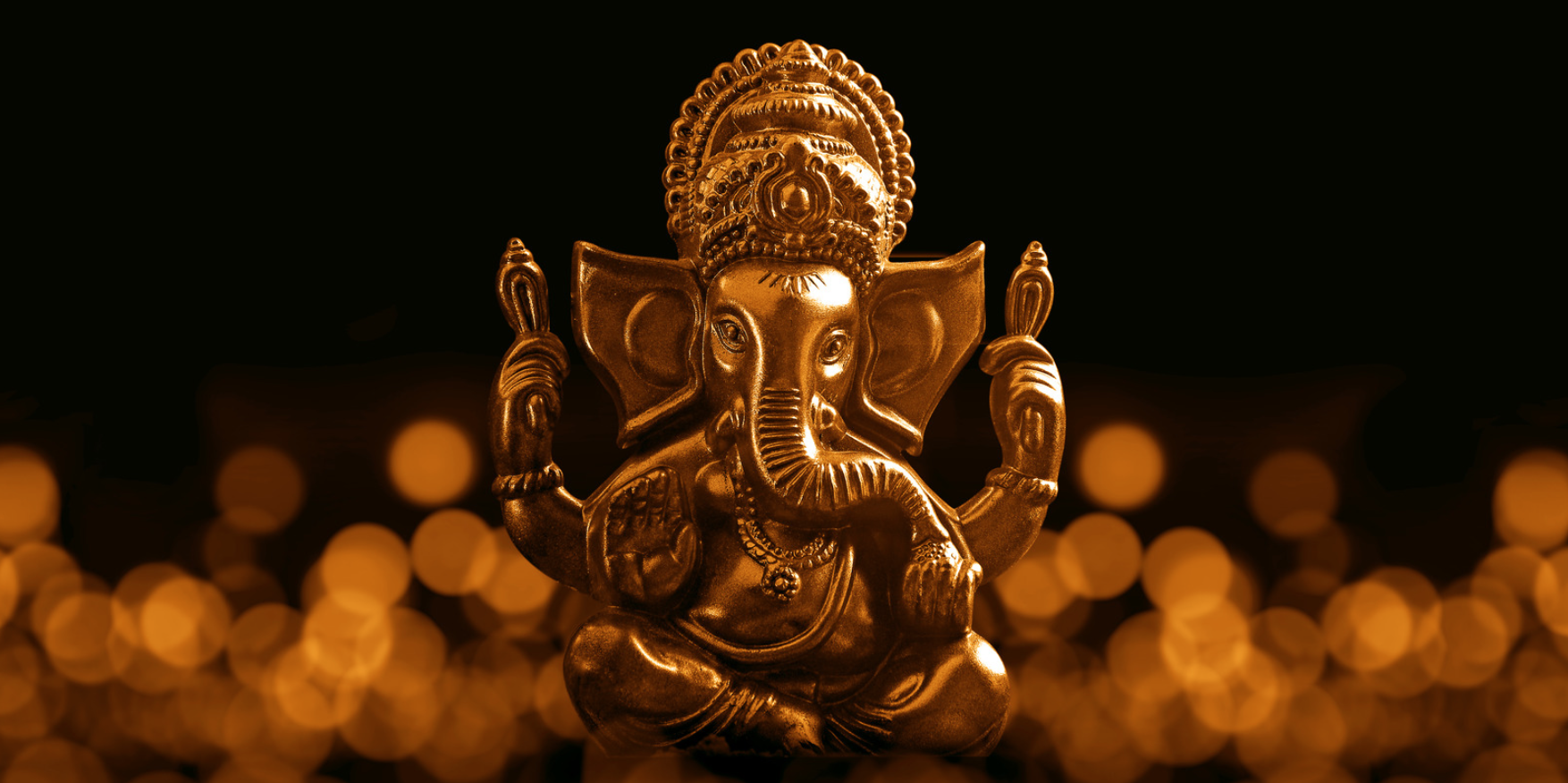
Gaṇeśa is a popular hero whose image adorns the walls of shops, homes, and temples throughout India. Even for people unfamiliar with Indian culture or the Vedic literature, Gaṇeśa is perhaps the easiest of all demigods to identify, with his human body, elephant head, and potbelly (Lambodara). He is usually pictured standing, sitting, or dancing, with his jolly elephant face looking straight ahead. Gaṇeśa is at times depicted with quill on palm leaf, for as Vyāsa dictated the Mahābhārata, Gaṇeśa served as the scribe to write it down.
Gaṇeśa is missing one tusk, a piece of which can sometimes be found in one of his four hands. In another hand he sometimes holds a hatchet (paraśu), which, according to some texts, is for cutting away illusion and false teachings. Another of Gaṇeśa's hands often gestures fearlessness and reassurance (varada-hasta-mudra). He also holds a goad (aṅkuśa) like that used by an elephant trainer, symbolizing his insistence on proper training or spiritual discipline. He sometimes holds a noose (pāśa) used for restraining wild animals, here representing the restraint of passion and lustful desires. Sometimes he is seen holding sweets (modaka), for which he is said to have an inordinate fondness. Hence the belly.
Who is this strange-looking god, and what, if anything, does he have to do with the worship of Kṛṣṇa or Viṣṇu?
Vedic texts reveal that Gaṇeśa is the son of Śiva and Pārvatī, although his sonship like that of his half-brother, Skanda-Subrahmanya, is peculiar. According to one version, Śiva "emits" from his body a handsome son who becomes a seducer of women. Pārvatī is offended by her son's exploits and curses him to have the head of an elephant and a big belly-in other words, to be ugly. Though with this he would seem fated to celibacy, he gradually settles down with two wives: Buddhi ("wisdom") and Siddhi ("success"), who can see beyond his physical ugliness.
As time passes, Gaṇeśa becomes the commander of Śiva's troops (gaṇa- īśa or gaṇa-pati), and because he be comes famous as one who creates obstacles for the demons and removes obstacles for the demigods or the devotees, he is known as Vighneśvara ("lord of obstacles") and Vināyaka ("one who removes [obstacles]"). The "obstacle" theme also tells us why Gaṇeśa uses a rat as his vehicle (Vāhana). As rodents generally succeed in gnawing their way through any obstruction, the mouse or rat, it is said, symbolizes Gaṇeśa's ability to destroy every obstacle.
In another, more popular version of the Gaṇeśa story, Pārvatī, wanting to seclude herself from her passionate husband, Śiva, especially while bathing, creates a son from her perspiration and appoints him the guardian of her quarters. Soon after, when Śiva seeks admission into Pārvatī's inner chambers, Gaṇeśa, unaware of Śiva's identity, refuses him, pushing him away from Pārvatī's door; Not one to be slighted, the enraged Śiva summons his attendants (gaṇās) to do away with this bothersome upstart. But Gaṇeśa defeats them one by one. Finally Viṣṇu arrives, and drawing upon His māyā (mystic potency) He creates confusion on all sides. This enables Śiva to cut off Gaṇeśa's head.
Pārvatī, furious at what has become of her "son," decides to send a multitude of goddesses to harass the demigods. These celestial women succeed in making it clear to the noble gods that their queen can be appeased only if her guardian is revived. Śiva then tells the gods to go north and cut off the head of the first living being they see. The head is to be mystically placed on the body of the decapitated Gaṇeśa, who will then come back to external consciousness. As fate would have it, the first living being to cross the path of the gods is an elephant.
The various Gaṇeśa stories described above -- found primarily in the Śiva Purāṇa and the Brahma-vaivarta Purāṇa -- are somewhat divergent, and tradition accounts for this by placing the variations in different cycles of cosmic time. "Because of the distinction between kalpas [ages]," the Śiva Purāṇa explains, "the story of Gaṇeśa's birth is told in different ways." The cyclical structure of Vedic time allows for repeated descents of the Lord and His devotees, so details of the pastimes may vary.
According to popular Indian tradition, Gaṇeśa is a benign and helpful deity who brings success and assures worldly well-being. Since devotees of Kṛṣṇa are more interested in spiritual realization than in worldly security, ISKCON tends to forgo the worship of Gaṇeśa. Lord Kṛṣṇa says in the Bhagavad-gītā (9.23), "Those who are devotees of other gods and worship them with faith actually worship only Me, O son of Kuntī, but they do so in a wrong way." Lord Kṛṣṇa uses the word avidhi pūrvakam: "in an inappropriate way." Why is such worship of demigods inappropriate? Because it is materially motivated. As Lord Kṛṣṇa says, "Men in this world desire success in fruitive activities, and therefore they worship the demigods." (Bg. 4.12)
Since we are essentially spiritual beings in a material body, material rewards can never truly satisfy us. Only spiritual rewards are satisfying for a spirit soul. Therefore Śrīla Prabhupāda concurring with the above two Gītā texts, says "[To worship] Gaṇapati is not necessarily required, but sometimes we do it. Just like the gopis-they worshiped Goddess Durgā, Kātyāyanī. They did not require to worship her, but that was part of the social system. But they asked, Mother Kātyāyanī, give us the opportunity to have Kṛṣṇa as our husband. Their aim was Kṛṣṇa." (Morning walk, Los Angeles, January 10, 1974)
So the worship of Gaṇeśa, like that of his mother, Durgā (Pārvatī), is not condemned, but it should be done for the proper reasons: Gaṇeśa is a devotee of Lord Kṛṣṇa, and we can pray to him to remove obstacles on the road to Kṛṣṇa consciousness. In this regard, Brahma- Saṁhitā (5.50) explains that Gaṇeśa is Kṛṣṇa's devotee. The success achieved by worshiping Gaṇeśa depends on Lord Kṛṣṇa, and therefore such worship should ultimately be directed to Kṛṣṇa: "For the power to destroy all obstacles to progress in the three mundane worlds, Gaṇeśa holds on his elephant head the lotus feet of Govinda. I worship Govinda, Kṛṣṇa, the primeval Lord."
The Śrī Brahma-saṁhitā Text 5.50 states: "I adore the primeval Lord Govinda, whose lotus feet are always held by Gaṇeśa upon the pair of tumuli protruding from his elephant head in order to obtain power for his function of destroying all the obstacles on the path of progress of the three worlds."
Satyarāja Dāsa is a disciple of Śrīla Prabhupāda and a regular contributor to Back to Godhead. He has written several books on Kṛṣṇa consciousness. He and his wife live in New York City
***
Download PDF
Sri-Ganesha-Stotram.pdf